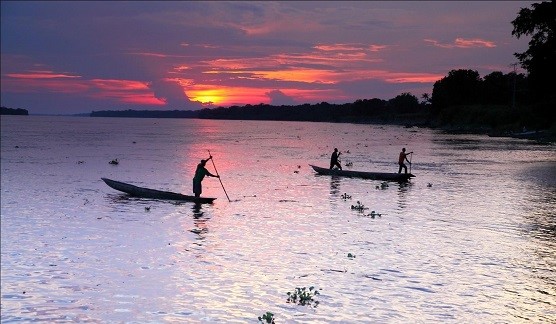
With a total length of 4371 kilometres, the Congo river is the second largest river in Africa, after the Nile. And with a debit of 40000 cubic metres per second, it is the second largest river in the world, after the Amazon. From its source in South Katanga, in the village of Musfi, at an elevation of 1435 metres, the river contours the entire country, passing through Kisangani, Mbandaka, Kinshasa and Matadi before reaching the Atlantic Ocean near Banana. The waters from the Congo river collide with the ocean waters some 45 kilometres out into the Atlantic. The Congo river basin offers a total of 14166 kilometres of navigable waters in the interior of the D.R.Congo
| Route | Days | Price | Ref | Date | Single suppl |
|---|---|---|---|---|---|
| Mbandaka - Lisala | 17 | 5.451 $ | TP1 | July 31 / Aug 16 | 395 $ |
| Lisala - Kisangani | 16 | 5.834 $ | TP2 | Aug 13 / Aug 28 | 365 $ |
| Mbandaka - Kisangani | 29 | 7.138 $ | TP3 | July 31 / Aug 28 | 535 $ |
| Route | Days | Price | Ref | Date | Single suppl |
|---|---|---|---|---|---|
| Kisangani - Lisala | 10 | 4.364 $ | TP4 | Aug 29 / Sept 07 | 305 $ |
| Lisala - Mbandaka | 12 | 4.563 $ | TP5 | Sept 04 / Sept 14 | 345 $ |
| Kisangani - Mbandaka | 17 | 5.417 $ | TP6 | Aug 29 / Sept 14 | 425 $ |
| Kisangani - Kinshasa included Bonobo at Mbou mon Tour farm | 29 | 10.954 $ | TP7 | Aug 29 / Sept 26 | 635 $ |
Our expedition covers the 1000 kilometres between Mbandaka and Kisangani, which is 2/3 of the largest navigable portion of the Congo river. Upstream, just beyond Kisangani, navigability is limited by a series of rapids, home of the world famous Wagenia Fisheries, extending over a total length of nearly 100 kilometres. Downstream, just beyond Kinshasa, navigability is limited by another series of rapids. Over a distance of 300 kilometres, the river drops 265 metres to reach the sea port of Matadi. Both not navigable sections are contoured by a railway in order to overcome natures barriers. The expeditions are being operated both upstream, from Mbandaka to Kisangani, and downstream, from Kisangani to Mbandaka and Kinshasa.
Our expedition has a maximum capacity of 12 clients, ensuring individual attention is offered to everyone. Expeditions are sold as private charters for a single person or up to parties of 12 persons. Groups of minimum 10 people can arrange their own date. HighlightsThe trip can be characterized by natural and cultural highlights, with some historical aspects. Some highlights of the cities or villages travellers will pass on the way:
Kinshasa, the capital of the D.R.Congo, used to be referred to as "Kin La Belle" - meaning "Beautiful Kinshasa". The many years of turmoil have broken down on this image. But slowly and surely, Kinshasa is regaining its splendour. Some of the major sites include the "Grand Marché", the tomb of former President Laurent Kabila, the "Academy des Beaux Arts" for those who like African art, the rapids of Kinsuka just downstream from the city and the Bonobo Reserve, a sanctuary for orphaned bonobo-monkeys, one of the five Great Apes, and the closest to mankind.
Mbandaka, the capital of the Equator province, lies on the equator. A marker on the Av. Bolenge symbolizes the line of the equator that passes through the city. The former President Mobutu Sese Seko attended school here. Mbandaka is one of the main river ports. The region of Mbandaka is the home of the Batswa Pygmies.
Lisala is the home town of the former President Mobutu Sese Seko. He was born here in a small municipal maternity clinic. A broad trunked tree - a "Libanga" - commemorates this event with a plaque: "This tree commemorates the birth of the Father of the Zairian Revolution, Mobutu Sese Seko, born on 14 October 1930."
In Bumba, the Congo river broadens out to its widest part, some 20 kilometres across. The river is covered with water hyacinths and practically paved with innumerable islands, through and around which the fishermen's pirogues ply. The water hyacinth is thought to have been introduced into Congo in 1960 by a South-American Missionary who brought seedlings of this flower in his luggage. It proliferated so wildly that the missionary tossed a few excess plants into the river. This innocent gesture has produced incalculable results, since the river hyacinths have become a real hazard to navigation. The region of Bumba is also the home of the Bafoto Pygmies.
Kisangani was founded by Sir Henry Morton Stanley in January 1877. Memorable sites include the Tshopo River Falls and the Wagenia fisheries, set up in the midst of river rapids. Fishing is carried on by means of a complex structure set among the rocks. Lianas attached to cross poles act as stretchers for the nets submerged in the foaming water. The fishermen go about their business in pirogues, plying among rapids and rocks. Their agility and daredevil boldness are an unfailing source of amazement.
The Yangambi Biosphere Reserve is a centre for research. Secondary forests with Pycnanthus angolensis and Fagara macrophylla, semi-deciduous secondary rain forests, rain forests with Gilbertiodendron dewevrei, climax forests with Brachystegia laurentii and marshland forests dominate the biosphere reserve. The site is very important from a biodiversity point of view since it hosts about 32,000 tree species. The elephant (Loxodonta africana cyclotis), the river hog (Potamochoerus porcus) and monkeys (Cercopithecus spp.) are among the most threatened species. Although there are no figures on the number of inhabitants of the area, some economic activities take place within the biosphere reserve boundaries such as agriculture, hunting, fishing, the production of canoes as well as some gold extraction. Numerous soils, silviculture and climate studies as well as experiments on the regeneration of the vegetation cover have been carried out.
Makanza is formerly New Antwerp. Previously it was called Bangala, founded by Hanssens in 1884 on the right bank at 375 m above sea level.