
TP 15 B Bonobo At Mbou Mon Tour Farm Down Streams 2026
Introduction
Tiger fishing in the D.R.Congo. Go Congo Tour Operator operates an 7, 10 or 14 day trip for those of you who dream to catch a giant tiger fish (Hydrocynus Goliath). Visit the Democratic Republic of Congo and hunt for the giant Goliath in a truly magical setting. You will be captivated by the beauty of nature untamed.
Created in 1997 by university executives and the villagers, the nongovernmental organization (NGO) "Mbou- Mon-Tour"(MMT) acts for the conservation of the environment and the local development. The presence of bonobos (Pan paniscus) was not confirmed by scientists of the Funds World for Nature (FWN) that is in 2005 while at the same time MMT called upon the international community since 2001 to obtain a support for the installation of community protection. The local majority ethnos group, Bateke, have a food interdict on the bonobos. Indeed, the bonobos are considered by this ethnos group as human which took refuge in the forest not to have honoured its debt, thus escaping an old usual law which made of an insolvent debtor the slave of his creditor. The installation of the actions of conservation and sensitizing by MMT makes it possible to reinforce and limit the erosion of this interdict.
In 2001 MMT accommodated the first round of the sensitizing for the DRC with the teaching trunk the large monkeys and their habitat. Today there are six sites of community conservation of the bonobos chosen by the local usual authorities in agreement with the population. These spaces are always accessible to human but the activities are reduced there (not hunting, no fields). Three of them regularly accommodate researchers and students of many countries (DRC, France, Belgium, the United States, Germany,..).
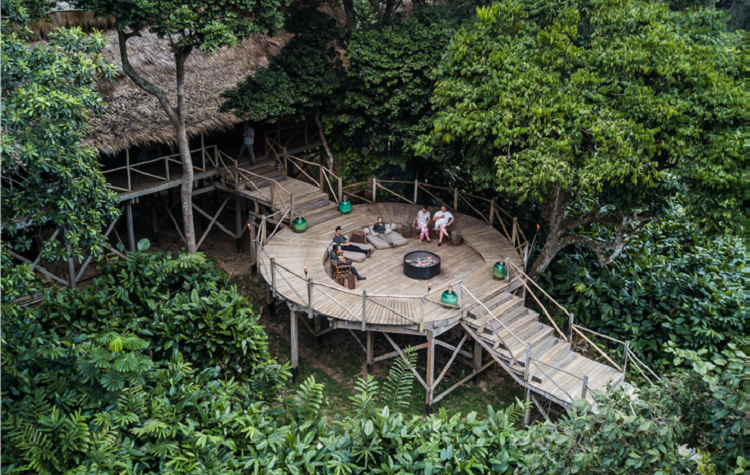
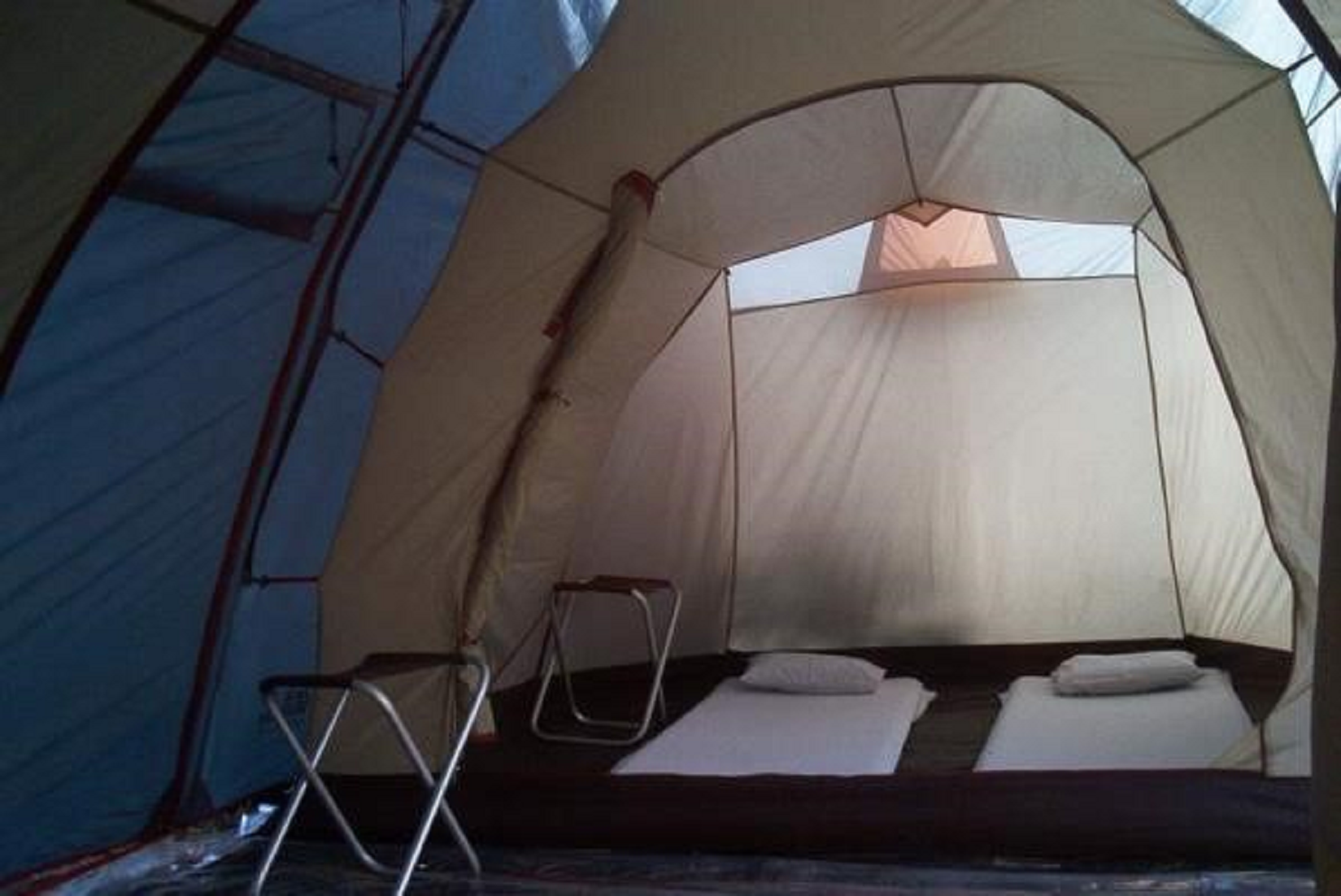
Accommodations consist of a hotel in Kinshasa and a tented encampment in the interior. As beds, we offer self-inflating mattresses with cotton mattress covers. Travellers are expected to bring their own bed linen. Travellers are expected to bring their own towels and shampoo/soap.
Mon Tour 2024
| Day 1 | Int. Arrival | x,x,x | Car | Hotel Sultani 3* |
| Day 2 | Departure Upstreams | B,L,D | Boat | Tents |
| Day 3 | Upstreams Congo River | B,L,D | Boat | Tents |
| Day 4 | Upstreams /transfer farm Mbou mon Tour | B,L,D | Boat/4x4 | Local acc |
| Day 5 | Malebo/Bonobo visit | B,L,D | Foot | Local acc |
| Day 6 | Malebo/Bonobo visit | B,L,D | Foot | Local acc |
| Day 7 | Return boat at Tchumbiri | B,L,D | Dugout canoe | Tents |
| Day 8 | Downstreams Congo River | B,L,D | Dugout canoe | Tents |
| Day 9 | Arrival Kinshasa | B,L,x | Boat/car | Hotel Sultani 3* |
| Day 10 | Kinshasa visit | B,x,x | Car | Hotel Sultani 3* |
| Day 11 | Int departure | B,x,x | Car | x |
The forest and its habitants
While in most other regions the bonobos live in swamp-forests, the animals in Bolobo live in a mosaic of forest and savannah. The soil is dry and access to the forest is very easy. The bonobos travel from one piece of forest to the other over the savannah. They also forage for fruits on the trees that grow on the savannah. Even though the forest seems to be largely intact, very few of its animals remain. Hunting has strongly decreased the populations of monkeys and other mammals. The trackers that work for the project rarely observe guenons, although De Brazza's monkeys (C. neglectus), Wolf's guenons (C.wolfi) and orange-nosed guenons (C. ascanius whitesidei) can still be found in the forest around the base. Fortunately, one of the group of trackers has recently discovered a small population of black mangabeys (Lophocebus aterrimus) and red colobus monkeys (Piliocolobus badius), which gives hope that the forest will be repopulated with a variety of small monkeys in the future. Nowadays hunting with guns is prohibited, and we can expect an increase of the populations of monkeys in the coming years. Primates are important for seed dispersal in the forest, and their conservation is indispensable for the future of the bonobos and the other animals of the forest. Other mammals have also become rare, but there is still a population of approximately 20 bush-elephants, there are buffaloes and several species of antelopes. Every autumn, a couple of lions visits the area, making victims in the herds of cows, and sometimes even human victims. It is interesting to note that the elephants and lions are not hunted by the locals anymore.
| Day1: | Airport Pick-Up Service upon arrival. Transfer to Hotel and briefing. Accommodation in Hotel. |
| Day2: | Transfer to Port. Travel by boat to Mai Ndombe. Accommodation in Tented encampment. |
| Day3: | Tiger fishing by boat. Accommodation in Tented Encampment. |
| Day4: | Tiger fishing by boat. Accommodation in Tented Encampment. |
| Day5: | Tiger fishing by boat. Accommodation in Tented Encampment. |
| Day6: | Tiger fishing by boat. Accommodation in Tented Encampment . |
| Day7: | Transfer to Airport. Airport Drop-Off Service at departure. |
| Depending on arrival and departure schedule from the international flight, often we can realize the trip airport - encampment or encampment - airport in one day without losing a whole day in Kinshasa |